
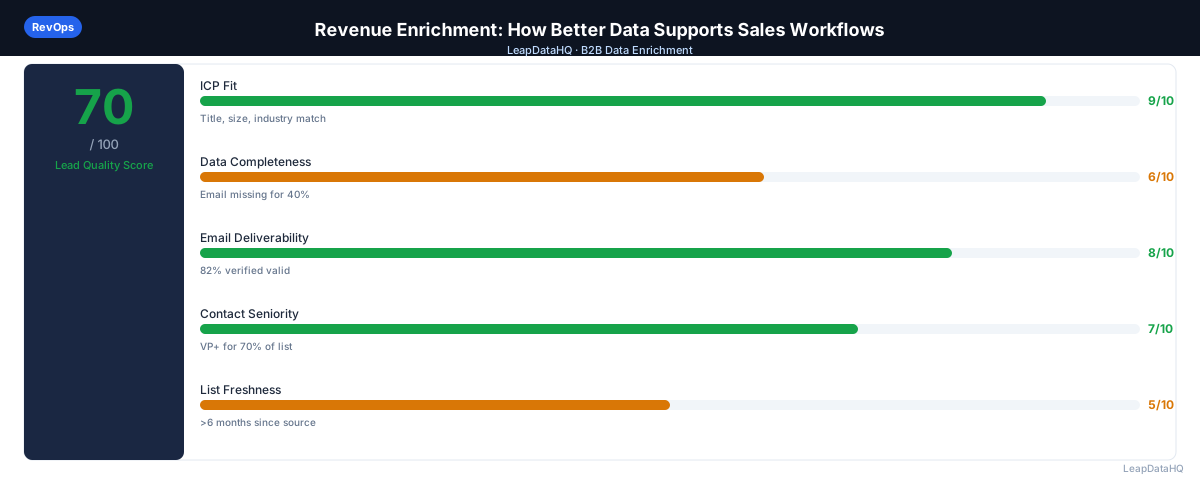
Revenue enrichment is the practice of improving your sales data quality to directly support revenue-generating activities. It goes beyond simply filling missing fields — it ensures that every piece of contact and company data in your CRM and outreach workflows is accurate, complete, and actionable for driving revenue.
For RevOps teams, sales leaders, and agency owners, data quality is not an abstract IT concern. It directly affects pipeline accuracy, forecasting reliability, SDR productivity, and campaign ROI. When your data is dirty, every downstream process suffers.
This guide explains what revenue enrichment means in practice, how better data supports each stage of the sales workflow, and how to build a data quality program that directly contributes to revenue growth. The goal is not just cleaner data — it is better business outcomes driven by data you can trust.
What Is Revenue Enrichment?
Revenue enrichment is a data quality strategy focused on improving the contact and company data that directly supports revenue operations. It combines data cleaning, data enrichment, email verification, and ongoing data maintenance into a unified program.
Unlike ad-hoc enrichment — where you clean a list right before a campaign — revenue enrichment is an ongoing practice. It ensures your CRM data stays clean, your outreach lists are always ready, and your forecasting is based on accurate pipeline data.
The key difference is the focus on revenue impact. Every data quality improvement is measured by how it affects pipeline accuracy, SDR efficiency, or campaign performance. Data quality becomes a revenue driver, not a maintenance task.
Why Revenue Enrichment Matters for Sales Workflows
Poor data quality affects every stage of the sales workflow:
- Prospecting: Incomplete lists mean SDRs spend 20-30% of their time hunting for contact information instead of selling
- Outreach: Invalid email addresses cause bounces that damage sender reputation and reduce campaign reach
- CRM management: Duplicate and incomplete records create confusion about account ownership and pipeline status
- Forecasting: Inaccurate company size and industry data lead to incorrect deal scoring and pipeline projections
- Reporting: Dirty data produces unreliable metrics that lead to poor strategic decisions
Revenue enrichment addresses each of these pain points by ensuring data is clean, complete, and verified at every stage.
Key Components of a Revenue Enrichment Program
CRM Data Hygiene
Regular CRM hygiene is the foundation of revenue enrichment. Run quarterly cleanup cycles to remove duplicates, standardize fields, fill missing data, and verify email addresses. A clean CRM gives your team a single source of truth for all sales activities.
Pre-Campaign List Preparation
Every outbound campaign should start with enriched data. Before launching any sequence, run your list through the complete enrichment workflow — clean, enrich, verify, segment. This ensures every campaign starts with the best possible data.
Ongoing Data Monitoring
Data quality degrades over time. Contacts change jobs, companies get acquired, domains change. Implement ongoing monitoring to catch data decay before it affects your campaigns. Quarterly re-enrichment of active prospect lists is a good starting point.
Ready to enrich your CSV list?
Upload a CSV, fill missing data, review confidence scores, and export clean records.
Upload a CSV — Start EnrichingTeam Training and Standards
Establish data entry standards for your team. Define how company names should be formatted, what fields are required for new contacts, and how to handle incomplete records. Consistent data entry prevents quality issues at the source.
How Revenue Enrichment Improves Forecasting
Accurate forecasting depends on accurate pipeline data. If your CRM contains duplicate contacts, incorrect company sizes, or outdated industry classifications, your pipeline reports will be unreliable.
Revenue enrichment ensures that deal sizes are attributed to the right companies, account tiers are based on accurate company data, and pipeline stages reflect real contact information. The result is forecasting you can actually trust for business decisions.
Measuring the Impact of Revenue Enrichment
Track these metrics to measure how revenue enrichment affects your sales workflow:
- Bounce rate before and after enrichment: target under 2%
- SDR time spent on data tasks vs selling activities: enrichment should reduce data time
- CRM data completeness percentage: target 90%+ for key fields
- Campaign reply rate before and after enrichment: enriched lists should perform better
- Forecast accuracy improvement: cleaner data means better predictions
Each metric connects directly to revenue impact. Lower bounce rates mean more contacts reached. Less data busywork means more selling time. Better forecasts mean smarter resource allocation.
Common Revenue Enrichment Mistakes
- Treating enrichment as a one-time project: Data quality requires ongoing maintenance, not a single cleanup pass
- Focusing only on email addresses: Company data and job titles are equally important for targeting and forecasting
- Not verifying enriched data: Enrichment without verification leads to downstream issues
- Ignoring CRM hygiene: If your CRM is dirty, your enrichment efforts start from a disadvantage
- Not measuring impact: Without metrics, you cannot prove the value of enrichment to stakeholders
How LeapDataHQ Helps
LeapDataHQ supports revenue enrichment programs through its CSV enrichment platform. You can clean and enrich CRM exports, prepare outreach lists, and verify email addresses — all in a single workflow that integrates with your existing sales stack.
For RevOps teams building a revenue enrichment program, LeapDataHQ provides the data quality layer that ensures your CRM, outreach campaigns, and forecasting systems all work from clean, complete, verified data.
The credit-based pricing at /pricing means you can run enrichment as needed — quarterly CRM cleanup cycles, pre-campaign list preparation, or ad-hoc data quality projects — without committing to annual contracts or seat-based fees.
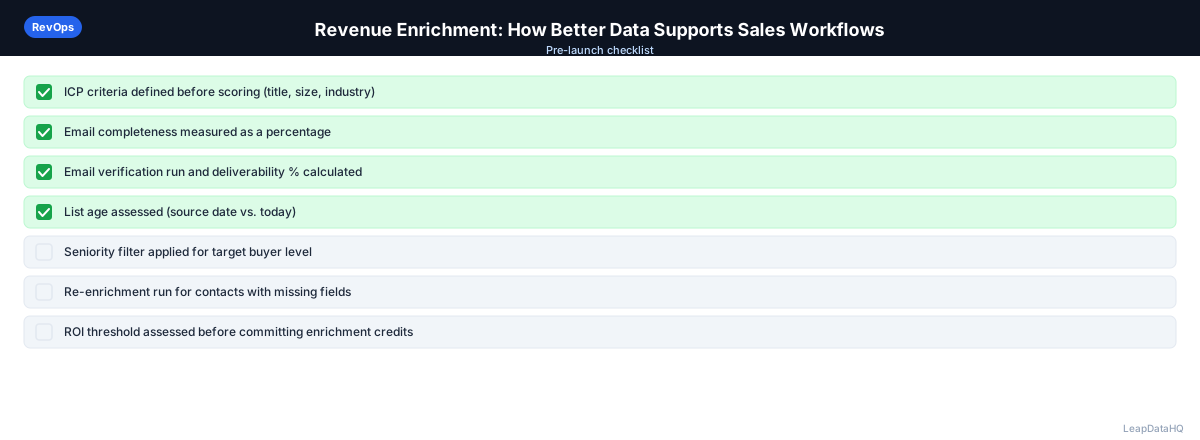
When to Use LeapDataHQ
LeapDataHQ supports revenue enrichment programs by providing the data quality tools needed to keep your CRM clean, your outreach lists ready, and your forecasting data accurate. Rather than maintaining multiple tools for different data quality tasks, LeapDataHQ provides a unified platform for cleaning, enrichment, and verification.
It is particularly valuable for RevOps teams that run regular data quality cycles, sales teams that need consistent pre-campaign list preparation, and agencies that manage data quality for multiple clients.
The credit-based pricing at /pricing means you pay only for what you enrich, making it cost-effective to run regular data quality cycles without budget surprises.
Start Enriching LeadsFrequently Asked Questions
How often should I run revenue enrichment cycles?
Run a full enrichment cycle at least quarterly for your active CRM contacts. Run pre-campaign enrichment for every new outbound list. Some teams run monthly cycles for their highest-priority prospect segments.
What is the ROI of revenue enrichment?
Teams that implement revenue enrichment programs typically see bounce rates drop from 5-10% to under 2%, SDR data-task time reduced by 50%, and campaign reply rates increase by 20-40%. The ROI is measurable within the first quarter.
Is revenue enrichment only for large teams?
No. Small teams and solo founders benefit even more because data quality issues have a proportionally larger impact on their limited outreach capacity.
How does revenue enrichment affect forecast accuracy?
Clean data directly improves forecast accuracy by ensuring pipeline records reflect real contacts, correct company information, and accurate deal stages. Dirty data produces forecasting errors that compound over time.
What is the first step in building a revenue enrichment program?
Start with a CRM data audit. Export your contacts, assess completeness and accuracy, and run an initial cleanup and enrichment pass. Establish a baseline, then set a regular enrichment cadence.