
Company revenue is one of the most useful — and most often missing — fields in B2B sales data. When you know that a prospect company generates roughly $5M in annual revenue, you have a much better sense of deal potential, budget availability, and whether they fit your ideal customer profile. When that field is blank, you're qualifying prospects manually on every call.
Revenue enrichment adds estimated or reported revenue data to your company records automatically. Combined with employee headcount, industry, and funding stage, revenue data gives you a more complete picture of each prospect account — one you can use to prioritize your outreach, estimate deal size, and personalize your messaging around company scale.
This guide covers how revenue enrichment works, what revenue data is actually available for most companies, and how to use it in your sales workflow.
Revenue enrichment addresses a specific pain point in B2B sales: the gap between knowing a company's name and knowing whether that company is worth pursuing. Without revenue data, sales teams qualify companies based on headcount alone, which can be misleading. A 50-person SaaS company and a 50-person manufacturing business have vastly different revenue profiles and buying capacities. Revenue data adds the financial dimension that headcount alone cannot provide, enabling more accurate qualification from the first touchpoint.
The quality of revenue enrichment data depends heavily on the company's public footprint. Public companies and VC-funded startups in active growth stages leave more data signals — SEC filings, press releases about funding rounds, customer count disclosures — that enrichment tools can aggregate into reliable estimates. Bootstrapped micro-businesses and companies in traditional industries with minimal online presence generate fewer signals, leading to lower coverage or wider estimated ranges. Understanding these coverage patterns helps you set realistic expectations for what revenue enrichment can deliver for your specific target market.
What Revenue Data Is Available Through Enrichment
Public companies report revenue in filings, so that data is reliable and verifiable. Private companies are a different story — only a small percentage voluntarily disclose revenue publicly.
For private companies, enrichment tools typically return estimated revenue ranges rather than exact figures. These estimates are derived from models that use employee headcount, industry, funding stage, and other signals to estimate revenue. They're useful for qualification and prioritization, but shouldn't be treated as verified revenue figures.
Revenue Ranges vs. Exact Revenue
Most enrichment tools return revenue as a range (e.g., $10M–$50M) rather than an exact number for private companies. This is appropriate given the estimation methodology. For B2B sales purposes, revenue ranges are usually sufficient:
- Under $1M: very early stage or bootstrapped micro-business
- $1M–$10M: small business with limited budget
- $10M–$50M: growing SMB with meaningful purchasing power
- $50M–$250M: established mid-market company
- $250M+: large enterprise with enterprise buying processes
How to Use Revenue Data in Your Sales Workflow
ICP Qualification
If your ICP includes a revenue minimum — for example, you only work with companies generating $10M+ annually — revenue enrichment enables you to filter prospect lists to this threshold before reaching out. This prevents time spent on companies that are too small to have meaningful budget for your product.
Deal Size Estimation
Revenue range correlates with expected deal size for many B2B products. A $5M company and a $100M company have very different budget capacities. Revenue data helps sales reps calibrate their pricing conversations and account prioritization before getting on a call.
Account Tiering
Use revenue range combined with headcount and industry to create account tiers. Tier 1 accounts (highest revenue range + strongest ICP fit) get high-touch outreach from senior reps. Tier 2 accounts get standard outreach sequences. Tier 3 accounts get lighter-touch digital campaigns.
Personalization
Revenue scale informs how you describe value. To a $2M company, you might emphasize accessibility and ROI in their context. To a $50M company, you might emphasize scale, integration, and support. Revenue data enables you to match your messaging to the prospect's context.
Ready to enrich your CSV list?
Upload a CSV, fill missing data, review confidence scores, and export clean records.
Upload a CSV — Start EnrichingRevenue Enrichment Limitations to Understand
- Accuracy varies: revenue estimates for private companies are models, not verified figures
- Not available for all companies: very small or very new companies may not have enough signals for reliable estimation
- Ranges not exact figures: useful for qualification and tiering, not for specific revenue conversations
- Can become outdated: fast-growing companies may move revenue brackets quickly
- Industry matters: revenue benchmarks differ significantly by industry and business model
Combining Revenue Data With Other Enrichment Fields
Revenue is most useful in combination with other company data:
- Revenue + Headcount: together give a clearer picture of company size and maturity
- Revenue + Industry: contextualizes scale (a $50M SaaS company is very different from a $50M manufacturing business)
- Revenue + Funding Stage: funded startups may have more budget than their revenue suggests
- Revenue + Growth Signals: growing companies may be better prospects than their current revenue indicates
Revenue Enrichment in Practice
A practical revenue enrichment workflow:
- Build your target company list (from LinkedIn, Crunchbase, directories)
- Upload to enrichment tool with company domain as primary lookup key
- Enrich for revenue range, employee count, industry, and funding stage
- Filter to companies in your target revenue range
- Do contact-level enrichment only for companies that pass the revenue filter
- Segment by revenue tier for account prioritization
- Route to appropriate rep and sequence based on tier
Revenue Enrichment Checklist
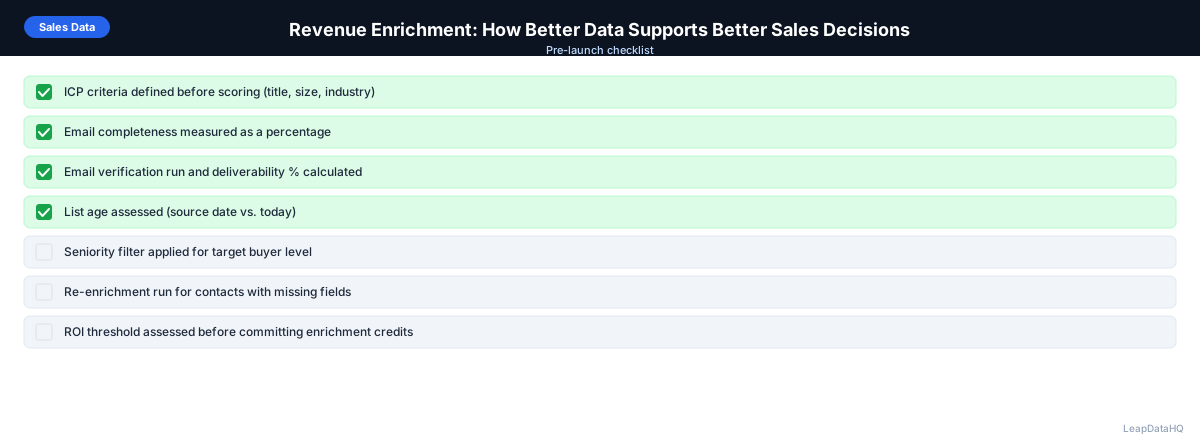
- Revenue range threshold defined for ICP qualification
- Company domain available as lookup key
- Enrichment run for revenue range, headcount, and industry together
- Results filtered to target revenue range before contact enrichment
- Revenue tier defined and applied for account prioritization
- Enrichment data re-verified annually for active accounts
- Revenue field used in CRM segmentation and reporting
Revenue Data versus Headcount Data
Revenue and headcount are complementary, not interchangeable. A company with 200 employees in professional services generates different revenue than a 200-employee SaaS company. Using headcount alone for qualification misses this distinction. Revenue enrichment provides the financial context that headcount cannot, enabling more precise ICP filtering and deal-size estimation across different business models and industries.
When both fields are available, using them together gives the clearest picture. A company with 50 employees and $10M in revenue is likely a high-margin or high-value-per-employee business, which signals either a premium offering or strong profitability. A company with 200 employees and $10M in revenue is likely in a lower-margin industry or earlier growth stage. The ratio of revenue to headcount — revenue per employee — is itself a useful metric for understanding company efficiency and spending capacity.
Integrating Revenue Data into Sales Processes
Revenue enrichment data is most valuable when it is built into sales workflows rather than treated as an optional field. Teams that make revenue range a required field for CRM import ensure that every prospect has baseline financial context before any outreach begins. This can be enforced through CRM validation rules or enrichment tool output filters that only export records with a revenue estimate within the target range.
Revenue data also improves forecast accuracy when combined with deal-stage tracking. Accounts in the same revenue tier tend to produce similar deal sizes and sales cycles, making pipeline projections more reliable. Over time, historical conversion data broken down by revenue tier helps refine ICP criteria and allocate sales resources more efficiently.
When to Use LeapDataHQ
LeapDataHQ enriches company-level data including revenue range, employee headcount, and industry alongside contact email addresses. This lets you qualify companies by revenue range in the same enrichment pass that finds contact emails — without running separate company and contact enrichment steps.
For sales teams that use revenue data as an ICP filter, this combined enrichment workflow saves time and reduces the cost of enriching contacts at companies that won't pass the revenue qualification anyway.
Start Enriching LeadsFrequently Asked Questions
How accurate is enriched revenue data for private companies?
Revenue estimates for private companies are model-based, not verified. They're useful for qualifying prospects into broad revenue tiers but shouldn't be treated as precise figures. For companies where exact revenue matters (e.g., revenue-based pricing), use the enriched estimate as an initial filter and verify in discovery conversations.
What's the difference between revenue enrichment and funding stage enrichment?
Revenue enrichment estimates a company's annual revenue. Funding stage enrichment identifies whether a company has raised venture capital and at what stage. Both are useful for qualification — revenue gives a sense of current business size, funding stage gives a sense of growth trajectory and capital availability.
Should I include revenue as a required field before outreach?
For products with a minimum revenue ICP requirement, yes. Use revenue range as a qualifying filter to avoid outreach to companies too small to be realistic buyers. For products with broad market fit across company sizes, revenue is more useful for prioritization (higher-revenue accounts get more attention) than as a hard filter.
What do I do when revenue data isn't available for a company?
For companies with no revenue data, use employee headcount as a proxy. Revenue and headcount are highly correlated for most business models. If neither is available, the company likely has very limited public data — consider whether they're worth manual research or whether to deprioritize.
How often does company revenue data need to be updated?
Revenue data should be refreshed annually for your active account database. Fast-growing companies can change revenue brackets significantly in a year. For high-priority accounts, check revenue signals (job postings, press releases, funding announcements) more frequently.