
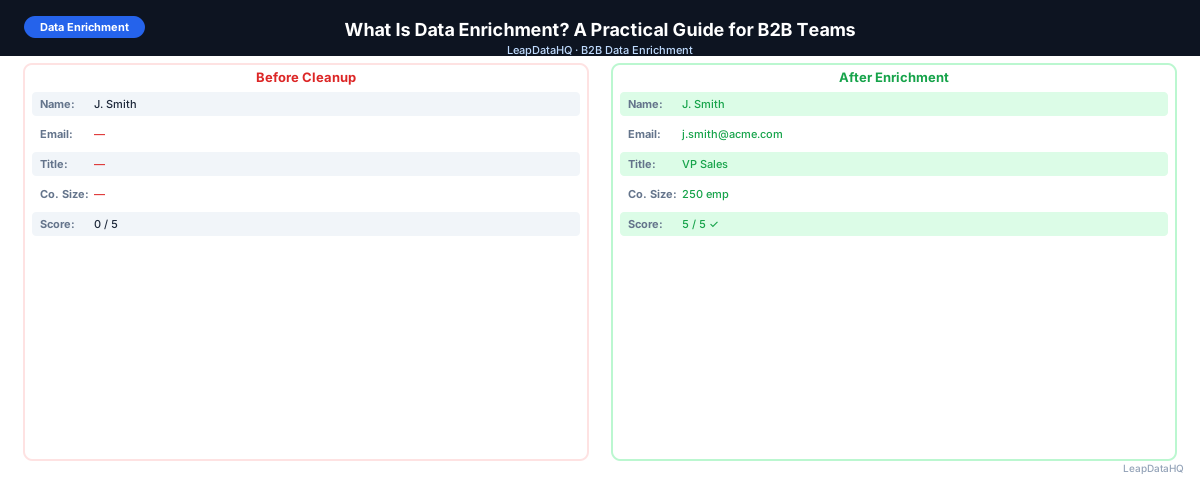
Data enrichment is the process of adding missing or additional information to an existing data record. In B2B sales and marketing, that usually means taking a partial contact or company record — maybe just a name and employer — and appending the email address, job title, company size, industry, phone number, and other fields you need to actually reach and understand that person.
Most teams encounter this problem every day. You identify a target company and find the right contact on LinkedIn, but the export doesn't include their email. You collect business cards at a conference but have no way to import them into your CRM with useful context. You buy a list and discover half the emails are missing or outdated.
Data enrichment solves that gap. Instead of manually researching each contact — a process that can take 3–5 minutes per row — an enrichment tool queries data sources and appends the missing information automatically. The result is a more complete record that's useful for outreach, segmentation, personalization, and reporting.
This guide covers how data enrichment works, what kinds of data you can enrich, who uses it, and how to evaluate whether an enrichment tool fits your workflow.
How Data Enrichment Works
At its core, data enrichment works by matching an input record to a data source. You provide an identifier — a company domain, a person's name and employer, or an email address — and the enrichment tool queries its database to find matching information and returns it alongside your original record.
The data sources enrichment tools use vary by provider. Some maintain their own proprietary database built from web crawling, public records, and partnerships. Others aggregate data from multiple third-party providers. Some rely on community-contributed data verified by their user base. The source of the data affects its coverage, freshness, and accuracy.
Most enrichment tools return a confidence score alongside the enriched data. This score indicates how certain the tool is about each piece of information. A high-confidence email is one the tool is very likely to be correct about. A low-confidence result might be the tool's best guess — worth reviewing before use.
Types of Data Enrichment
Contact Enrichment
Contact enrichment adds person-level data to a record. Starting from a name and employer, you can typically enrich work email address, direct phone number, job title, seniority level, department, and LinkedIn profile URL. This is the most common enrichment use case for B2B outbound sales.
Company Enrichment
Company enrichment adds organization-level data to a record. Starting from a company name or domain, you can enrich industry, employee headcount, revenue range, headquarters location, company type (public, private, nonprofit), funding stage, technology stack, and social media profiles. This data is used for ICP filtering, account scoring, and personalization.
CSV Enrichment
CSV enrichment is enrichment applied to a batch of records uploaded as a spreadsheet file. Instead of enriching contacts one at a time through an API, you upload a CSV of contacts or companies, the tool processes all records in parallel, and you download an enriched version of the file. This is the most common workflow for sales teams, agencies, and marketers who work primarily with spreadsheets.
CRM Enrichment
CRM enrichment fills gaps in an existing CRM database. You export records with missing fields, run them through an enrichment tool, and import the results back. This can also happen automatically through CRM integrations that trigger enrichment when new records are created.
What Fields Can Be Enriched?
The most commonly enriched contact fields include:
- Work email address
- Direct phone number
- Job title and department
- Seniority level (VP, Director, Manager, IC)
- LinkedIn profile URL
- Years in role or at company
Commonly enriched company fields include:
- Industry and sub-industry classification
- Employee headcount (exact or range)
- Annual revenue (estimated or reported)
- Headquarters city, state, and country
- Technology stack (software tools in use)
- Funding stage, amount, and lead investor
- Year founded
- Company type (public, private, nonprofit, subsidiary)
Who Uses Data Enrichment?
Data enrichment is used across B2B go-to-market functions:
- Sales teams and SDRs: to complete prospect records before outreach and fill CRM gaps
- Marketing teams: to enrich inbound leads with company context and improve segmentation
- Revenue operations: to maintain CRM data quality and improve reporting accuracy
- Lead generation agencies: to deliver complete, outreach-ready prospect lists to clients
- Recruiters: to find contact information for passive candidates sourced from LinkedIn
- Founders and business development: to build outreach lists without dedicated research staff
The Data Enrichment Workflow
Ready to enrich your CSV list?
Upload a CSV, fill missing data, review confidence scores, and export clean records.
Upload a CSV — Start EnrichingA standard B2B enrichment workflow follows these steps:
- Identify your target contacts or companies from LinkedIn, directories, events, or CRM exports
- Organize them in a spreadsheet with the identifying fields you have (domain, name, company)
- Clean the input: remove duplicates, standardize domain formats, check for obvious errors
- Upload to an enrichment tool and map your columns to the correct input fields
- Review the enriched output and confidence scores — filter to records you trust
- Verify email addresses before loading into your outreach tool
- Import enriched, verified records into your CRM or email sequencer
- Track bounce rates and reply rates to measure data quality over time
Data Enrichment vs. Data Scraping
These terms are sometimes confused but describe different processes. Data scraping involves automated extraction of data directly from websites, which may violate platform terms of service. Data enrichment, as described here, involves querying a data provider's database using an identifier you already have.
Legitimate enrichment tools maintain their own databases or license data from authorized sources. They don't scrape LinkedIn, for example — they maintain their own contact databases built through other means. Understanding this distinction matters for compliance and vendor evaluation.
What to Look for in a Data Enrichment Tool
- Coverage for your target market: match rates vary by industry, company size, and geography
- Confidence scoring: tools that flag uncertain results give you better control over quality
- CSV upload support: most non-technical users need file-based enrichment, not API-only tools
- Flexible pricing: credit-based models work better for variable enrichment volumes than seat-based models
- Data freshness: how often the underlying database is updated affects accuracy for job-changers
- GDPR and compliance posture: ensure the vendor has appropriate data handling practices
Common Data Enrichment Mistakes
Using Enriched Data Without Reviewing Confidence Scores
Importing everything regardless of confidence level is the most common enrichment mistake. Low-confidence results should be reviewed manually or excluded. Using them directly leads to high bounce rates and inaccurate personalization.
Enriching Before Cleaning Your Input Data
Dirty input produces dirty output. Duplicate rows waste credits. Inconsistent domain formats produce mismatches. Always clean your input CSV before uploading to an enrichment tool.
Treating Enrichment as a One-Time Event
B2B contact data decays at roughly 20–30% per year as people change jobs. Enrichment is most valuable when done regularly — before each outreach campaign, quarterly for CRM records, and whenever a list hasn't been touched in six months.
Expecting 100% Match Rates
No enrichment tool matches every record. Expect 60–80% for email enrichment on a typical B2B list. Lower match rates for very small businesses and higher rates for established companies in technology, finance, and professional services.
Data Enrichment and Compliance
B2B data enrichment for sales outreach operates in a different regulatory context than consumer data. In most jurisdictions, contacting business contacts at their work email for relevant B2B purposes is permissible under legitimate interest provisions.
Best practices: always include an unsubscribe option in outreach, do not use enriched data for unrelated marketing, work with enrichment vendors that have appropriate data handling agreements, and comply with applicable regulations in your target regions (CAN-SPAM in the US, CASL in Canada, GDPR in Europe).
Data Enrichment Checklist
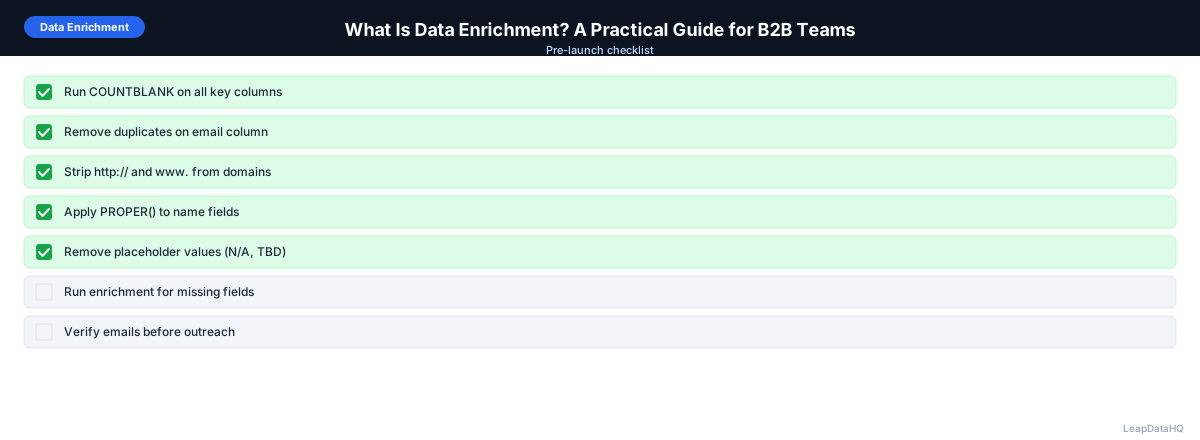
- Input file cleaned: duplicates removed, domains standardized
- Columns mapped correctly in enrichment tool
- Confidence scores reviewed before export
- Low-confidence results filtered out or flagged for manual review
- Email addresses verified before sending
- Enriched data segmented by company size, industry, or title
- Results imported into CRM or outreach tool with correct field mapping
- Bounce rate tracked post-campaign to measure data quality
- Re-enrichment scheduled for contacts not updated in 6+ months
Start Enriching Your Data
If you have a list of B2B contacts or companies that's missing key fields, data enrichment can fill those gaps in minutes rather than days. LeapDataHQ helps you upload a CSV, enrich for email addresses and company data, review confidence scores, and export a clean list ready for outreach. See our features and pricing to get started.
When to Use LeapDataHQ
LeapDataHQ is built for the core data enrichment use case described in this guide. You bring a CSV of company names, domains, or partial contact records; the tool queries its data sources and returns enriched records with confidence signals; you filter to the records you trust and export them for use in your outreach, CRM, or marketing workflow.
It fits best for batch enrichment — uploading a file of 50–5,000 records and getting results back quickly — rather than real-time API enrichment or single-record lookup. If you're a sales team, agency, or marketer working primarily with spreadsheets, this is the workflow LeapDataHQ is designed around.
The credit-based pricing means you pay only for what you enrich. No seat fees, no annual contracts, no minimum monthly commitments. Enrich 100 records one month and 2,000 the next without your pricing changing unexpectedly.
For teams getting started with data enrichment, LeapDataHQ offers a low-friction way to test the workflow: upload a sample of your actual target data, see match rates and confidence scores, and decide whether the output quality fits your use case before committing to larger volumes.
Start Enriching LeadsFrequently Asked Questions
What is data enrichment in simple terms?
Data enrichment means adding missing information to a record you already have. In B2B sales, that typically means taking a company name or contact record and appending the email address, job title, company size, and other fields needed to reach and understand that person or organization.
How accurate is B2B data enrichment?
Accuracy varies by tool, industry, company size, and geography. For contacts at established companies in technology, finance, and professional services, accuracy tends to be higher. For very small businesses or international contacts, expect more variation. Confidence scores from the enrichment tool help you identify which results to trust.
Is data enrichment legal?
For B2B outreach using work email addresses, data enrichment is generally permissible in most jurisdictions when used for legitimate business purposes. Always include an unsubscribe option, comply with applicable regulations like CAN-SPAM and GDPR, and work with enrichment vendors who maintain appropriate data handling practices.
What is the difference between data enrichment and a prospecting database?
A prospecting database lets you search for and discover new contacts by filtering criteria like industry, title, and company size. Data enrichment takes records you already have and adds missing fields. They solve different problems: prospecting databases help you find new targets; enrichment tools help you complete the records you've already identified.
How often should I enrich my contact data?
B2B contact data decays at roughly 20–30% per year. Enrich before each new outreach campaign for the best results. For CRM records, a quarterly re-enrichment pass on active contacts and an annual pass on inactive records is a sustainable cadence for most B2B teams.
What is a good match rate for data enrichment?
For email enrichment on a well-prepared B2B list, 60–80% is typical. Match rates are higher for established companies with consistent email patterns and lower for very small businesses or companies with limited public data. Always test with a representative sample of your actual target market before committing to a tool.