
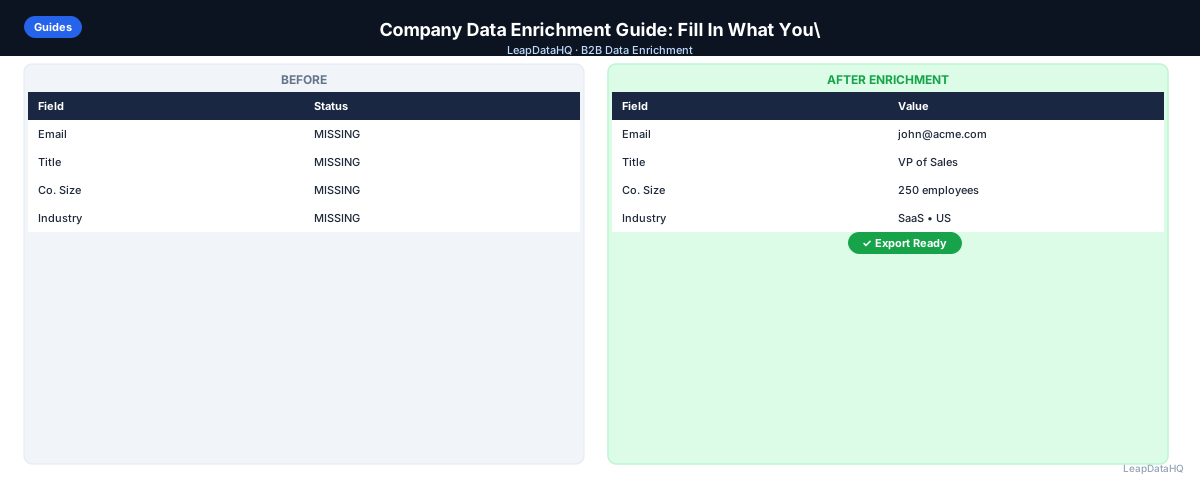
Contact enrichment and company enrichment solve different but related problems. Contact enrichment gets you the email address and phone number of the person you want to reach. Company enrichment tells you whether that company fits your ideal customer profile — and gives you the context you need to personalize your outreach.
A list of contacts without company data is hard to segment, hard to prioritize, and hard to personalize effectively. Company data fills in the context: what size is this company, what industry are they in, what tools do they use, and how quickly are they growing?
This guide covers company data enrichment — what you can add, how to get it, and how to use it. You'll learn what company data fields can be enriched, why company enrichment matters for B2B targeting, and how to use company data for personalization and segmentation.
Whether you're building a target account list from scratch or trying to qualify an existing list of companies, company enrichment is the foundation for effective B2B prospecting.
What Is Company Data Enrichment?
Company data enrichment is the process of appending organization-level data to a company record. Starting from a company name or domain, enrichment returns firmographic data — size, industry, revenue, location — plus technographic data (what software they use) and other signals that help you understand the company.
This is distinct from contact enrichment, which focuses on individual people. Company enrichment operates at the organization level and is used primarily for ICP filtering, segmentation, and account-based targeting. You can think of it as building a complete profile of the company before you invest time in finding the right contacts within it.
The output of company enrichment is a structured record with fields like industry classification, employee headcount range, revenue estimate, headquarters location, technology stack, and funding information. These fields enable you to filter, prioritize, and personalize at the company level.
What This Means for Your Workflow
Company enrichment transforms a list of company names or domains into a filterable, segmentable dataset. Instead of treating all companies equally, you can identify which ones match your ICP, prioritize outreach to the best-fit accounts, and personalize messaging based on company characteristics.
For teams doing outbound prospecting, company enrichment is the first step in the enrichment workflow. Before you invest in finding contact emails, you should verify that the company is worth targeting. Company enrichment provides that filtering layer, ensuring you only do contact enrichment on companies that pass your ICP criteria.
The practical impact: instead of enriching contacts at 500 companies and then discovering that 300 don't match your ICP, you enrich company data first, filter to 200 ICP-fit companies, and then enrich contacts only at those 200. This approach saves enrichment credits and focuses your outreach on the right targets.
Who Should Use Company Data Enrichment
Company data enrichment is valuable for any B2B team that needs to identify, qualify, and target accounts based on firmographic criteria.
- Sales teams building target account lists for outbound prospecting
- SDRs qualifying inbound leads by checking company fit against ICP criteria
- Agencies building segmented lists for clients across different industries and company sizes
- Marketing teams running account-based marketing campaigns to specific target accounts
- Founders identifying potential customers in their target market
- RevOps teams maintaining accurate company data in the CRM for reporting and segmentation
- Business development teams researching potential partnership opportunities
If you need to know whether a company fits your ICP before investing time in outreach, company enrichment provides that answer. It's the foundation for effective targeting and prioritization in B2B prospecting.
What Company Data Fields Can Be Enriched?
- Company name and legal entity
- Primary domain and website
- Industry and sub-industry classification
- Employee headcount range
- Revenue range or estimated ARR
- Headquarters location (city, state, country)
- Company type (public, private, nonprofit)
- Funding stage and investors
- Technology stack (software tools used)
- Year founded
- Social media profiles (LinkedIn, Twitter)
- Description and tagline
Why Company Enrichment Matters for B2B Targeting
Without company data, your target account list is just a list of names. With company data, it becomes a filterable, segmentable dataset you can actually use for prioritization and targeting. You can answer questions like: which companies are in my target industries? Which are in my target size range? Which use compatible technology?
Example: you build a list of 500 companies from a LinkedIn search. Before enrichment, you can't efficiently filter by size or identify which are in your target revenue range. After enrichment, you filter to 200 companies that match your ICP, then do contact-level enrichment only on those 200 — saving time and enrichment credits.
Company enrichment also enables personalization. When you know a company's industry, size, and technology stack, you can write outreach that speaks directly to their situation. This relevance is what separates effective outreach from generic spam.
Company-First vs. Contact-First Enrichment
The most efficient enrichment workflow starts at the company level. Enrich company data first to filter your account list to ICP-fit companies. Then do contact-level enrichment only for the companies that make it through the filter. This approach optimizes your enrichment budget by ensuring you only pay for contact enrichment on companies worth targeting.
Doing contact enrichment on all 500 companies before filtering means paying for enrichment on 300 companies you'll discard. Company-first enrichment optimizes your enrichment budget and focuses your outreach efforts on the right targets.
How to Use Company Data for Personalization
Company data enables personalization that goes beyond just using the contact's name. When you know the company's industry, size, technology stack, and growth stage, you can write outreach that speaks directly to their specific situation. This level of personalization significantly improves reply rates because it demonstrates that you've done your research and understand their context.
Effective personalization using company data includes referencing recent company news or funding rounds, mentioning compatible technology integrations, acknowledging industry-specific challenges, and tailoring your value proposition to the company's size and maturity level. A 50-person startup needs different messaging than a 5,000-person enterprise, even if they're in the same industry.
- Reference the company's industry in your opening line
- Mention the company's size to show you understand their context
- Use tech stack data to highlight integrations or compatibility
- Reference funding stage to acknowledge where they are in growth
- Cite the company's headquarters for local relevance when appropriate
Ready to enrich your CSV list?
Upload a CSV, fill missing data, review confidence scores, and export clean records.
Upload a CSV — Start EnrichingData Quality Considerations for Company Enrichment
Company data is generally more stable than contact data — companies don't change industries or headquarters as often as individuals change jobs. However, company size data can become outdated quickly for fast-growing or contracting companies, and technology stack data changes as companies switch tools.
For high-growth startups and companies in dynamic markets, plan to re-enrich company data annually at minimum. For more stable companies, annual re-enrichment is usually sufficient. The key is to match your re-enrichment cadence to the rate of change in your target market.
Checklist: Company Enrichment Workflow
Use this checklist when running a company enrichment workflow:
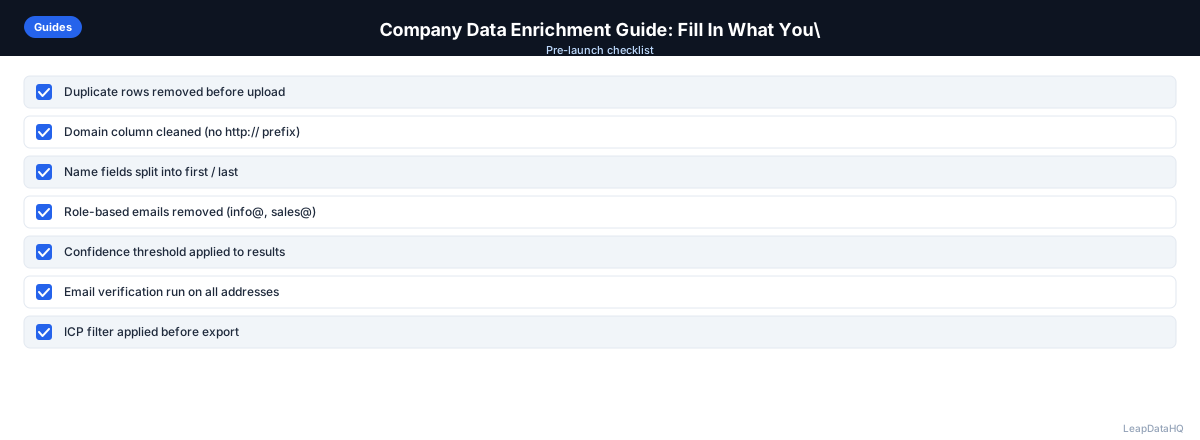
- Input list includes company domains (most reliable lookup key)
- Domains are standardized (no http://, www., or trailing slashes)
- Duplicates have been removed from the input list
- Enrichment tool is configured to return firmographic data fields
- Results are filtered to ICP-fit companies before contact enrichment
- Company size data is reviewed for fast-growing companies that may have changed
- Technology stack data is used for segmentation if relevant to your product
- Enriched company data is imported into CRM for ongoing reference
- Re-enrichment schedule is set based on target market dynamics
- Company data is used for personalization in outreach templates
Common Mistakes to Avoid
- Using company name instead of domain as the lookup key. Company names are ambiguous — there can be multiple companies with similar names. Domains are unique identifiers that produce more accurate enrichment results.
- Doing contact enrichment before company enrichment. This wastes enrichment credits on contacts at companies that don't fit your ICP. Always filter at the company level first.
- Not using company data for personalization. Enrichment returns valuable context about each company. If you don't use industry, size, and tech stack data in your outreach, you're missing the value of enrichment.
- Ignoring company size changes for fast-growing companies. Headcount data can become outdated quickly for startups in hypergrowth. Verify size data for companies in dynamic markets.
- Not re-enriching company data periodically. Company data decays over time — companies change industries through acquisitions, grow in size, and switch technology stacks. Plan regular re-enrichment passes.
- Enriching all companies without ICP filtering. Enrichment credits are wasted on companies outside your target market. Define ICP criteria and filter before enriching contacts.
- Not integrating company data into CRM. Enrichment output should flow into your CRM so reps can see company context during outreach. Isolated enrichment data that doesn't reach the CRM has limited value.
- Treating all company data fields as equally reliable. Some fields (industry, headquarters) are more stable than others (headcount, tech stack). Weight your decisions accordingly.
Practical Examples
Example 1: SaaS Company Building Target Account List
A B2B SaaS company building a target account list started with 1,000 company domains from LinkedIn searches. After company enrichment, they filtered to 400 companies matching their ICP (50-500 employees, technology industry). Contact enrichment on those 400 companies produced 320 decision-maker emails. The company-first approach saved 60% on contact enrichment costs.
Example 2: Agency Segmenting Client Prospects by Industry
An agency running outreach for a financial software client enriched 600 company domains. The enrichment revealed 200 companies in financial services, 150 in insurance, and 250 in other industries. The agency created separate sequences for financial services and insurance prospects, each with industry-specific messaging. Reply rates doubled compared to unsegmented outreach.
Example 3: Startup Using Tech Stack for Targeting
A startup selling Salesforce integrations can enrich company domains and filter to prospects that already use Salesforce, then lead outreach with integration compatibility and a reference to the prospect's existing investment. Targeting on a relevant shared context usually converts better than untargeted campaigns.
Example 4: Enterprise Sales Team Prioritizing Accounts
An enterprise sales team can enrich target account domains and use revenue range and headcount data to tier accounts into priority levels. Higher-priority accounts receive personalized outreach from senior reps, while others receive standard SDR outreach, which focuses effort where it is most likely to pay off.
Example 5: Marketing Team Using Company Data for ABM
A marketing team running an ABM campaign can enrich target account domains and use company size, industry, and tech stack data to create account-specific messaging that references each prospect's industry challenges and technology context. Relevant, personalized messaging generally improves ABM conversion.
How LeapDataHQ Helps
LeapDataHQ enriches at both the company and contact level. When you upload a CSV of company domains, it returns firmographic data (industry, size) alongside contact information — so you can filter to ICP-fit companies and get contact emails in the same workflow. This company-first plus contact enrichment approach optimizes your enrichment budget.
This is particularly useful for agencies and SDRs who want to build ICP-qualified, contact-enriched lists from a single upload rather than running separate company and contact enrichment passes. The confidence scores returned for both company and contact data help you filter to high-quality results before outreach.
The credit-based pricing means you pay only for what you enrich, making it practical to run company enrichment as a filtering step before investing in contact enrichment. This two-stage approach is more cost-effective than enriching all contacts upfront and then discovering which companies don't fit your ICP.
Next Steps
If you're building a target account list, start with company enrichment to filter to ICP-fit companies before investing in contact enrichment. LeapDataHQ provides both company and contact enrichment in a single workflow with confidence scores to help you filter effectively. Check our /features and /pricing to see if it fits your prospecting workflow.
When to Use LeapDataHQ
LeapDataHQ enriches at both the company and contact level. When you upload a CSV of company domains, it returns firmographic data (industry, size) alongside contact information — so you can filter to ICP-fit companies and get contact emails in the same workflow.
This is particularly useful for agencies and SDRs who want to build ICP-qualified, contact-enriched lists from a single upload rather than running separate company and contact enrichment passes. The two-stage approach — company enrichment first, then contact enrichment on ICP-fit companies — optimizes your enrichment budget.
The credit-based pricing means you pay only for what you enrich. You can run company enrichment on 1,000 domains, filter to 400 ICP-fit companies, and then enrich contacts only on those 400. This is more cost-effective than enriching all 1,000 contacts upfront.
For teams building target account lists from domain data — trade publication mentions, conference lists, technology vendor directories — LeapDataHQ provides the enrichment layer that turns a raw domain list into a targeted, enriched prospect list ready for outreach.
Start Enriching LeadsFrequently Asked Questions
What's the most useful company data field for B2B targeting?
Company size (headcount) and industry are consistently the most useful for ICP filtering. Technology stack is highly valuable if your product has integrations. Revenue range is useful for deal-size qualification. The most useful fields depend on your specific ICP criteria and sales motion.
How accurate is company headcount data from enrichment tools?
Headcount data from enrichment is typically accurate within a range (e.g., 100-200 employees) based on publicly available signals like LinkedIn profiles and job postings. For precise headcount, check the company's most recent public filings or LinkedIn page directly. Headcount ranges are usually sufficient for ICP filtering purposes.
Can I enrich company data without a domain?
It's possible but less accurate. Enrichment tools can look up companies by name, but there may be multiple companies with similar names. A domain is the unique identifier that produces the most reliable company data. If you only have company names, consider adding domains first using a company name-to-domain lookup.
What's technographic data and how is it used?
Technographic data is information about the software and technology a company uses — their CRM, marketing automation platform, cloud provider, analytics tools. It's used to identify prospects that use complementary or competing tools and to personalize outreach around integrations. This data is particularly valuable for products with integration capabilities.
How often does company data change?
More slowly than contact data. Industry and headquarters are stable for most companies. Headcount and tech stack can change quarterly for fast-growing companies. Funding stage changes at each funding round. Plan a re-enrichment pass annually for static attributes and more frequently for dynamic ones like headcount and tech stack.
Should I enrich company data or contact data first?
Company data first, then contact data. Enrich company data to filter your account list to ICP-fit companies. Then do contact enrichment only on the companies that pass your ICP filter. This two-stage approach saves enrichment credits by avoiding contact enrichment on companies you'll discard anyway.
What if company enrichment returns incomplete data for some companies?
Not all companies have complete public data, especially very small or very new companies. For companies with incomplete enrichment results, supplement with manual research on LinkedIn or the company website. High-value targets are worth the additional manual effort when enrichment doesn't return complete data.