
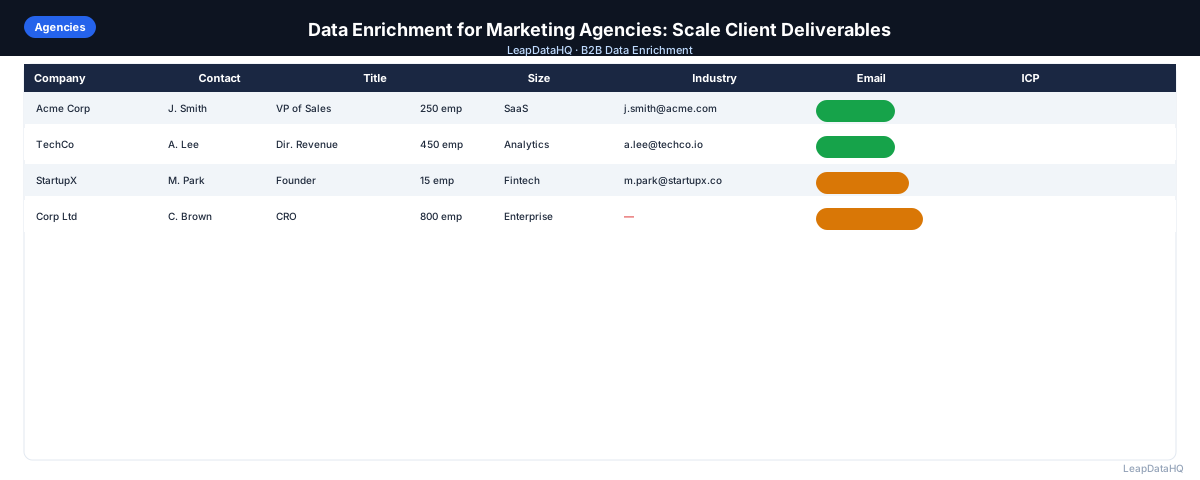
Marketing agencies that do lead generation, outbound prospecting, or account-based marketing for clients need reliable, scalable enrichment capabilities. The challenge is that each client has a different ICP, different target markets, and different deliverable requirements — which means the enrichment workflow needs to be both flexible and consistent.
Agencies that build a systematic enrichment process deliver better client results, reduce per-list production time, and can take on more volume without proportional headcount increases.
This guide covers how to build that process. You'll learn how to create a scalable enrichment workflow, standardize your input and output formats, price enrichment as a service, and deliver quality that builds client retention.
Whether you're a solo consultant or a 20-person agency, these principles will help you build an enrichment process that scales with your client portfolio.
The Agency Enrichment Challenge
Unlike in-house sales teams enriching their own CRM, agencies work across multiple client accounts simultaneously. A list for a B2B software client looks completely different from a list for a professional services firm. The enrichment fields that matter for one client may be irrelevant for another.
The agencies that handle this well have a modular workflow: the enrichment process is consistent, but the inputs, outputs, and quality thresholds are customized per client. This modularity lets you scale across clients without rebuilding your process for each engagement.
The alternative — custom workflows for each client — doesn't scale. As your client portfolio grows, you spend more time on process management than on actual enrichment work. A standardized approach with client-specific configuration is the key to profitable agency enrichment.
What This Means for Your Agency
A systematic enrichment process directly affects your agency's profitability and client retention. When enrichment is fast and consistent, you can take on more clients without adding headcount. When quality is high, clients see better campaign results and stay longer.
For agencies, enrichment is not just a tool — it's a service offering. You can price enrichment as a standalone deliverable, bundle it into lead generation retainers, or use it to improve the quality of your campaign management services. The right enrichment workflow becomes a competitive advantage.
The practical impact: agencies with strong enrichment processes deliver lists faster, with higher quality, and at better margins than agencies doing manual research. This difference compounds as your client portfolio grows.
Who Should Use This Agency Enrichment Workflow
This workflow is designed for agencies that deliver lead lists or prospecting services to B2B clients.
- Lead generation agencies delivering enriched prospect lists to clients
- Outbound prospecting agencies running cold email campaigns on behalf of clients
- Account-based marketing agencies building target account lists for clients
- Digital marketing agencies adding lead generation to their service offerings
- Recruiting agencies building candidate and client prospect lists
- Consulting firms providing go-to-market strategy with enriched target lists
- Freelancers and solo consultants providing lead generation services
If your agency delivers prospect lists or runs outreach campaigns for clients, a systematic enrichment process is essential. The workflow described here scales from solo consultants to agencies with multiple team members managing client accounts.
Building a Scalable Agency Enrichment Workflow
Step 1: Create a Client Intake Template
Before building any list, document the client's targeting criteria using a standard template: industry, company size, geography, job titles, exclusions. This brief prevents scope creep and ensures the list you deliver matches what the client actually needs.
The intake template should capture: target industries (with specific sub-industries if relevant), company size range (headcount or revenue), geographic focus (countries, regions, or specific markets), job titles or functions to target, and any exclusions (competitors, existing customers, specific companies). This brief becomes the specification for your enrichment workflow.
Step 2: Standardize Your Input CSV Format
Use the same column names and order for every client: company_name, domain, first_name, last_name, job_title, linkedin_url. This makes enrichment tool column mapping instant — you're not remapping fields for every new client.
Standardization also makes quality control easier. When every client's input follows the same format, you can apply the same cleaning and validation rules across all engagements. This reduces errors and speeds up the enrichment process.
Step 3: Run Enrichment and Document Match Rates
Upload the standardized CSV, run enrichment, and document the match rate. Low match rates should be investigated and explained in your client deliverable — they often indicate input quality issues or gaps in the tool's coverage for that client's target market.
Documenting match rates by client and by target market helps you set realistic expectations for future engagements. If a particular client's target market consistently produces 60% match rates, you can plan for that and price accordingly.
Step 4: Filter by Confidence Before Delivery
Only deliver high-confidence results to clients. Low-confidence emails that bounce after delivery create client relationship issues. It's better to deliver 200 high-confidence contacts than 400 mixed-confidence ones.
Define a confidence score threshold for delivery — typically 75% or higher. Explain this filtering step in your deliverable documentation so clients understand why the final count may be lower than the raw enrichment output. This transparency builds trust and demonstrates your commitment to quality.
Pricing Enrichment as an Agency Service
Enrichment can be priced as a standalone service or bundled into broader engagements. The right pricing model depends on your service offering and client expectations.
- A per-record fee included in a lead generation retainer
- A deliverable-based fee (e.g., $X per batch of Y enriched records)
- A value-based component of a broader campaign budget
- A cost pass-through with a service markup for the enrichment work
Credit-based enrichment tools make cost calculation straightforward: input size times cost per credit equals enrichment cost. Add your time for cleaning, reviewing, and formatting, and you have a deliverable cost basis. Most agencies apply a 2-3x markup to cover their time and expertise.
When pricing enrichment services, consider the value you're delivering to the client, not just your cost. A well-enriched list that generates 10 meetings for a client is worth far more than the cost of the enrichment credits. Price based on the outcome you enable, not just the inputs you provide.
For retainer clients, bundle enrichment into your monthly deliverables rather than billing separately. This simplifies billing and positions enrichment as part of your comprehensive service rather than a line-item expense. For project-based clients, price enrichment as a distinct deliverable with clear scope and output specifications.
Delivering Quality That Builds Client Retention
Ready to enrich your CSV list?
Upload a CSV, fill missing data, review confidence scores, and export clean records.
Upload a CSV — Start EnrichingThe enrichment quality you deliver directly affects client campaign performance. Enriched lists that produce low bounce rates and relevant contacts lead to better campaign results — which leads to longer retainers and referrals.
Document your quality process in your client deliverables. Including a brief methodology note ("We cleaned, enriched, and filtered to records with 75%+ confidence scores") demonstrates professionalism and explains why your match rate may be lower than the raw input. Clients appreciate transparency about your process.
Tools and Infrastructure for Agency Enrichment
- A credit-based enrichment tool that doesn't require per-seat fees per client
- A standardized CSV cleaning template (Excel or Google Sheets)
- A client brief template that captures targeting criteria before sourcing
- A deliverable output template that clients can import directly into their sequencer or CRM
- A tracking sheet for enrichment credits used per client (for accurate billing and budget management)
The right infrastructure makes your enrichment process repeatable and scalable. When every team member uses the same templates, tools, and workflows, quality stays consistent regardless of who executes the work. This consistency is what allows agencies to scale their client portfolio without proportional headcount increases.
Invest time upfront in building these templates and documenting your process. The initial investment pays for itself quickly as you take on more clients and your team grows. Standardized processes also make training new team members faster and more effective.
Scaling Your Agency Enrichment Operation
As your agency grows, your enrichment operation needs to scale accordingly. This means hiring and training team members on your standardized processes, managing enrichment costs across a growing client portfolio, and maintaining quality as volume increases.
The key to scaling is maintaining your standardized workflow while delegating execution. Document every step of your process so that any team member can execute it consistently. Use project management tools to track enrichment engagements across clients. And regularly review match rates, quality metrics, and client satisfaction to identify areas for improvement.
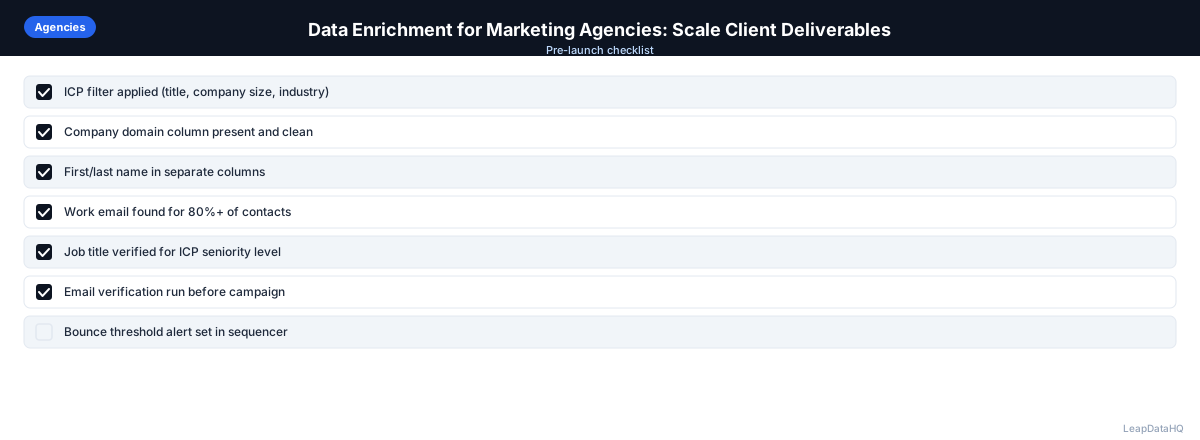
Checklist: Agency Enrichment Workflow
Use this checklist for each client enrichment engagement:
- Client intake template is completed with targeting criteria
- Input CSV follows standardized format with consistent column names
- Input data is cleaned and deduplicated before enrichment
- Enrichment tool is configured with correct column mappings
- Match rate is documented and compared to expectations
- Results are filtered to high-confidence records before delivery
- Output CSV follows standardized deliverable format
- Methodology note is included explaining enrichment process and filtering
- Enrichment credits used are tracked for client billing
- Deliverable is QA-reviewed before sending to client
Common Mistakes to Avoid
- Not using a standardized intake template. Without a clear brief, you'll build lists that don't match client expectations, leading to rework and scope creep. The intake template prevents miscommunication and sets clear expectations.
- Not standardizing input CSV formats. Different column names for each client means remapping fields for every engagement. Standardization makes the process repeatable and reduces errors.
- Delivering low-confidence results to clients. Low-confidence emails bounce, damaging client campaign performance and your reputation. Filter to high-confidence results before delivery, even if it means delivering fewer contacts.
- Not documenting match rates and methodology. Clients need to understand why the final deliverable may be smaller than the raw input. Documentation builds trust and demonstrates your quality process.
- Not tracking enrichment costs per client. Without accurate cost tracking, you can't price engagements profitably. Track credits used per client and include this in your billing.
- Not QA-reviewing deliverables before sending. Errors in client deliverables damage trust. Have someone other than the person who built the list review it before delivery.
- Using different enrichment tools for different clients. This creates inconsistency and makes it hard to compare results across clients. Use one tool for all clients to maintain consistency.
- Not building a reusable process. Each client engagement should follow the same workflow with client-specific configuration. This makes the process scalable and reduces per-client production time.
Practical Examples
Example 1: Lead Generation Agency with 10 Clients
A lead generation agency managing several B2B clients can standardize its enrichment workflow with a single credit-based tool. Each client's list goes through the same process: intake brief, standardized input, enrichment, confidence filtering, and formatted output. Standardizing the workflow tends to cut production time per client and keeps campaign bounce rates consistently low across accounts.
Example 2: ABM Agency Building Target Account Lists
An ABM agency built target account lists for 5 enterprise clients. They used domain enrichment to build company profiles, then filtered to ICP-fit accounts before doing contact enrichment. This two-stage approach saved 40% on enrichment costs compared to enriching all contacts upfront. Client satisfaction improved because lists were more tightly targeted.
Example 3: Solo Consultant Providing Enrichment as a Service
A solo consultant offered enriched prospect lists as a standalone service. They charged $2 per enriched contact with a minimum of 100 contacts. Using a credit-based enrichment tool at $0.30 per credit, their gross margin was 85%. The standardized workflow let them serve 8 clients simultaneously without overhead.
Example 4: Digital Marketing Agency Adding Lead Gen
A digital marketing agency added lead generation to their service offerings. They built a standardized enrichment workflow that integrated with their existing campaign management process. Clients could now get complete campaigns — from enriched lists to sent emails — as a bundled service. Average client revenue increased 60%.
Example 5: Recruiting Agency Enriching Candidate Lists
A recruiting agency enriched candidate lists for their clients. They standardized on a format that included contact information, current company, job title, and LinkedIn URL. The enriched lists helped their clients (hiring companies) reach passive candidates more effectively. Placement rates improved 25% with enriched data.
How LeapDataHQ Helps
LeapDataHQ is built for the agency enrichment workflow. No developer integration required, credit-based pricing that scales with your volume, CSV upload and download, and confidence scores that support the quality filtering step before client delivery. The workflow is simple enough for any team member to execute consistently.
For agencies handling enrichment for multiple clients simultaneously, the ability to run batches for different clients with the same account — without per-client seat fees — makes it practical to scale across a growing client portfolio. You pay only for what you enrich, making it easy to track costs per client and price engagements profitably.
The confidence scores returned during enrichment are particularly valuable for agencies. They enable the quality filtering step that protects client campaign performance and builds trust. Delivering only high-confidence results demonstrates your commitment to quality and differentiates your agency from competitors who deliver unfiltered enrichment output.
For agencies looking to add enrichment as a standalone service or bundle it into broader engagements, LeapDataHQ's credit-based model makes cost calculation straightforward. You can price enrichment deliverables with confidence, knowing your exact cost basis and maintaining healthy margins. The transparency in pricing also makes it easy to explain your value to clients.
The standardized CSV workflow means that every team member can execute enrichment consistently, regardless of which client they're working on. This consistency is critical for agencies that need to maintain quality across multiple client engagements and team members. The simple upload-map-review-export process reduces training time and minimizes errors.
Next Steps
If your agency is doing manual enrichment or using inconsistent processes across clients, standardize your workflow using the steps above. LeapDataHQ provides the enrichment layer that fits into agency processes without requiring per-client contracts or developer setup. Check our /features and /pricing to see if it fits your agency's needs.
When to Use LeapDataHQ
LeapDataHQ is built for the agency enrichment workflow. No developer integration required, credit-based pricing that scales with your volume, CSV upload and download, and confidence scores that support the quality filtering step before client delivery.
For agencies handling enrichment for multiple clients simultaneously, the ability to run batches for different clients with the same account — without per-client seat fees — makes it practical to scale across a growing client portfolio. You pay only for what you enrich, making it easy to track costs per client and price engagements profitably.
The confidence scores returned during enrichment enable the quality filtering step that protects client campaign performance. Only deliver high-confidence results to clients, and document your filtering methodology in your deliverables. This transparency builds trust and demonstrates your commitment to quality.
For agencies looking to add enrichment as a standalone service or bundle it into broader engagements, LeapDataHQ's credit-based model makes cost calculation straightforward. You can price enrichment deliverables with confidence, knowing your exact cost basis and maintaining healthy margins.
Start Enriching LeadsFrequently Asked Questions
How do agencies handle enrichment for clients in different industries with different data needs?
Build a modular approach: the enrichment process is the same, but the input targeting criteria and output filters vary per client. Document each client's requirements in a brief and use that brief to select the relevant output fields for each deliverable. The workflow stays consistent; the configuration changes per client.
Should agencies build their own enrichment capability or use a tool?
Building enrichment infrastructure in-house requires significant technical investment. For most agencies, using a specialized enrichment tool is more practical and cost-effective — you pay for the enrichment capacity you need without building and maintaining your own data infrastructure. Focus your investment on client relationships and campaign strategy.
How do agencies ensure consistent list quality across different team members?
Document your enrichment process in a standard operating procedure. Use the same input template for all clients. Assign a QA step where someone other than the person who built the list reviews it before delivery. Consistency comes from process, not from individual effort.
What's a fair turnaround time to promise clients for enriched lead lists?
For lists up to 500 contacts, 2-3 business days is achievable. This allows time for sourcing, cleaning, enriching, reviewing, and formatting. Set expectations upfront and build buffer into your timeline for input quality issues. Faster turnaround is possible for smaller lists or repeat engagements with standardized inputs.
How do agencies handle clients who want to enrich very niche or international markets?
Set expectations about match rates before delivery — niche or international markets often have lower enrichment coverage. Supplement with manual research for the highest-value targets where automation doesn't return results. Charge accordingly for the additional manual effort. Document match rates by market to inform future pricing.
How should agencies price enrichment services?
Calculate your cost basis (enrichment credits plus your time) and apply a 2-3x markup. Price per enriched contact delivered (not per input record) to align your pricing with client value. Consider tiered pricing based on list size or market difficulty. Bundle enrichment into broader campaign services for higher-value engagements.
What if a client's target market has consistently low match rates?
Document the match rates and explain them to the client. Low match rates may indicate a very niche market, international coverage gaps, or input quality issues. Adjust your pricing to reflect the additional effort required. Consider supplementing with manual research for high-value targets. Set expectations early to avoid client disappointment.