
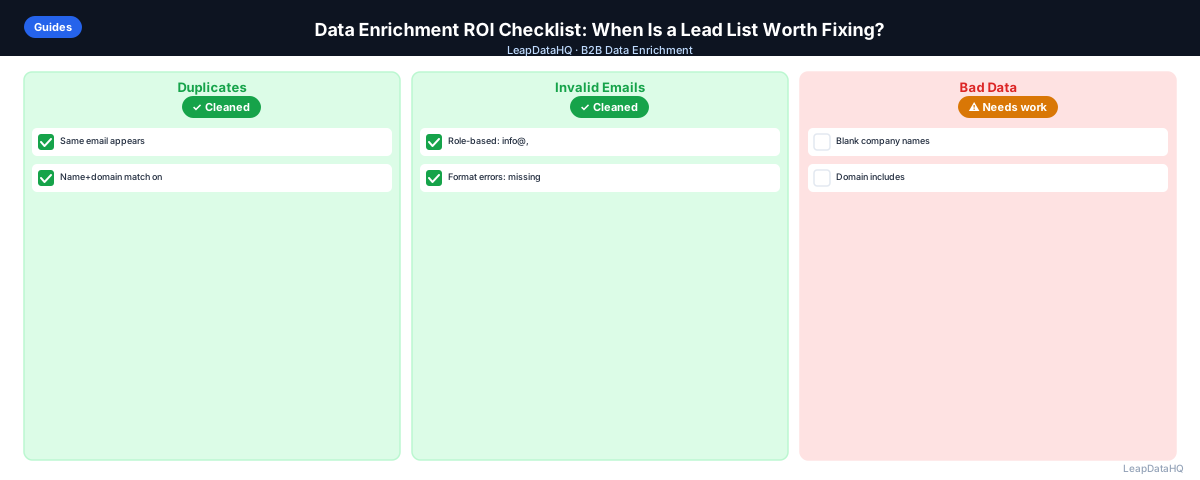
Data enrichment isn't free — it costs credits, time to review results, and the ongoing workflow overhead of running it consistently. Before committing to enriching a lead list, it's worth asking whether the list is actually worth fixing.
Not every list is. A list of 500 contacts at companies well outside your ICP isn't worth enriching — finding emails for the wrong people doesn't help. A list that's six years old from a market you no longer serve isn't worth enriching. A list of 20 contacts that you could research manually in 30 minutes might not justify the enrichment tooling overhead.
This ROI checklist helps you evaluate the business case for enriching a specific lead list before you invest in it. It covers contact quality, ICP fit, expected match rate, downstream conversion opportunity, and alternative approaches — so you can make an informed decision rather than defaulting to "enrich everything."
The decision to enrich should consider both the direct and indirect costs. Direct costs are the easy part — credits per record, verification fees, and the time your team spends running the enrichment process. Indirect costs matter just as much but are harder to measure: the opportunity cost of time spent cleaning a bad list instead of sourcing a better one, the downstream CRM data quality problems caused by enriching poorly-matched contacts and importing them into your system, and the reputational cost of sending outreach from a list that was never good enough to produce replies.
Teams that routinely enrich every list they receive without evaluating the business case often end up in a pattern where they spend more on enrichment than the resulting pipeline justifies. A simple before-enrichment evaluation prevents this by making the investment decision explicit, with clear criteria for when to proceed, when to proceed conditionally, and when to skip enrichment and address the root cause — a bad list that no amount of enrichment will fix.
The Basic ROI Equation for Lead List Enrichment
Lead list enrichment is worth it when the value of successfully enriched contacts exceeds the cost of the enrichment process. The value side includes: expected number of successful contacts (match rate × list size), expected reply rate on enriched vs. unenriched lists, expected conversion from reply to meeting, expected revenue per meeting. The cost side includes: credits consumed, time spent on review and cleanup, email verification costs.
You don't need precise numbers to use this framework — rough estimates are enough to distinguish "clearly worth it," "borderline," and "not worth it" cases.
Section 1: Contact Quality Assessment
- ☐ Source quality: where did this list come from? (LinkedIn export, conference list, data vendor, manual research, CRM export)
- ☐ Age of the list: when was this list created or last verified? (Under 3 months = fresh; 3–12 months = moderate decay; 12+ months = significant decay)
- ☐ Initial completeness: what percentage of contacts already have email addresses? (>60% complete = enrichment fills a smaller gap; <30% complete = enrichment does more work)
- ☐ Format quality: are domains and names in clean format, or is significant cleanup needed before enrichment? (More cleanup = more time cost)
- ☐ Estimated match rate: what percentage of contacts do you expect the enrichment tool to match? (Based on industry, company size, geography — SMB in niche industries has lower match rates than mid-market in mainstream industries)
Section 2: ICP Fit Assessment
- ☐ Company size alignment: do the companies on this list match your ICP company size range?
- ☐ Industry alignment: do the industries on this list match your target verticals?
- ☐ Title alignment: do the contact titles (where visible) match your ICP buyer personas?
- ☐ Geography alignment: are the companies in your target geographies?
- ☐ Overall ICP score: roughly what percentage of contacts on this list do you expect to pass ICP criteria? (<30% = enrichment cost is high relative to usable output; >60% = enrichment is more efficient relative to usable contacts)
Section 3: Downstream Conversion Opportunity
- ☐ Campaign relevance: do you have a campaign or product offer ready that's appropriate for this list?
- ☐ Estimated reply rate: what's your expected reply rate from outreach to this type of list? (Industry benchmarks: 1–3% for cold outreach, 5–10% for warm or semi-targeted lists)
- ☐ Pipeline value per reply: what's the average revenue opportunity if a contact from this list replies and engages?
- ☐ Time to close: how long is the typical sales cycle for opportunities sourced from this type of contact?
- ☐ Urgency: does this list have a time-sensitive use case (conference follow-up, product launch outreach) that reduces its value if not acted on quickly?
Section 4: Cost Estimate
Ready to enrich your CSV list?
Upload a CSV, fill missing data, review confidence scores, and export clean records.
Upload a CSV — Start Enriching- ☐ Enrichment cost: estimated credits based on list size and expected match rate
- ☐ Review time cost: estimated time to review enriched results at confidence threshold
- ☐ Verification cost: estimated email verification cost for enriched email addresses
- ☐ Cleanup time cost: estimated time for format cleanup, deduplication, and ICP filtering
- ☐ Total cost estimate: credits + verification + (hours × your hourly cost)
Decision Criteria
Enrichment is clearly worth it if: ICP fit is >60%, estimated match rate is >50%, list size is large enough that enrichment is faster than manual research, and there's an active campaign ready to use the enriched contacts.
Enrichment is borderline if: ICP fit is 30–60%, match rate is 30–50%, or the list is old enough that staleness reduces expected results. In this case, consider enriching a subset (filter to the strongest ICP signal rows first) rather than the full list.
Enrichment is not worth it if: ICP fit is <30%, the list is more than two years old without re-sourcing, the list is too small to justify tooling overhead (under 20 contacts, consider manual research instead), or you don't have an active campaign ready to use the results.
Alternative Approaches When Enrichment Isn't Worth It
- Manual research: for lists under 20–30 contacts, direct LinkedIn research or email finder tool use (single-contact, not bulk) is faster than a full enrichment workflow
- List replacement: for very old or poorly-fitting lists, starting fresh from a better source may be more efficient than enriching a bad list
- ICP pre-filter: filter the list to only ICP-fit rows before enrichment — enrich 100 well-targeted contacts rather than 500 mixed-quality contacts
- Phased enrichment: enrich in batches, starting with highest-priority contacts; stop if early batch results don't meet quality expectations
Common Misconceptions About Enrichment ROI
A common misconception is that enrichment always improves campaign results. Enrichment only helps if the enriched contacts are actually reachable and relevant. Enriching a list of wrong contacts — people who have left the companies you are targeting, or people in roles outside your ICP — produces enriched data for contacts that should never have been in your outreach pipeline. The enrichment step only fills in missing fields; it does not fix targeting problems.
Another misconception is that enrichment ROI should be measured per-contact rather than per-campaign. A campaign-level view gives a more accurate picture because the cost of enrichment is incurred once for the entire list, while the value comes from the subset of contacts that convert. A list may have a low per-contact enrichment ROI but a high campaign-level ROI if even a small number of enriched contacts produce significant pipeline. The per-contact view would say it was marginal; the campaign view says it was worthwhile.
Teams also sometimes assume that higher enrichment spend produces proportionally better results. In practice, enrichment returns are diminishing — the first 50% of matches (high-confidence, easy-to-find contacts) deliver most of the campaign value, while the remaining matches require progressively more spend per usable contact. Setting a minimum confidence threshold and stopping enrichment for records below that threshold prevents overspending on low-quality matches that contribute little to campaign outcomes.
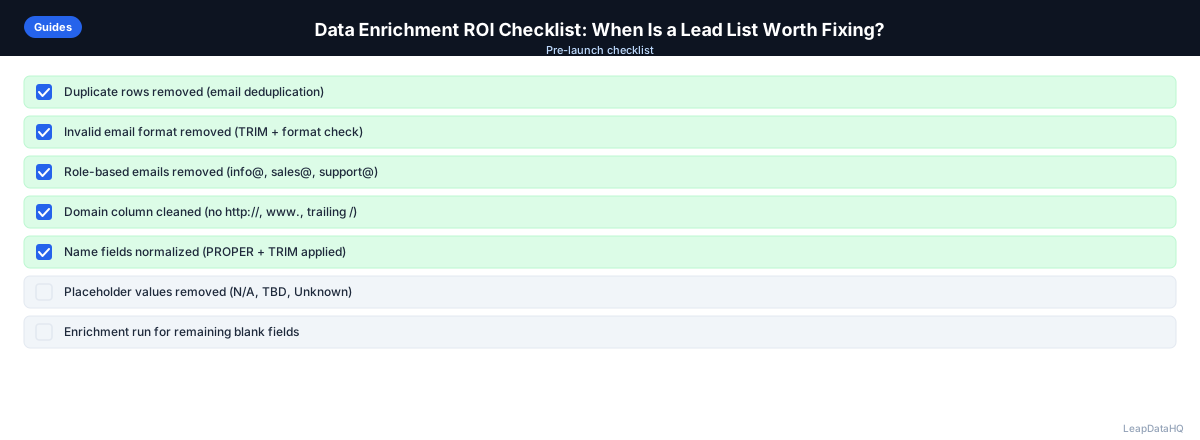
When to Use LeapDataHQ
Use this checklist before starting any enrichment project in LeapDataHQ. For lists that pass the checklist (high ICP fit, reasonable match rate expectations, active campaign use case), proceed with upload and enrichment. For borderline lists, apply the ICP pre-filter to reduce the enrichment set before uploading. For lists that don't pass the checklist, skip enrichment and address the underlying list quality problem instead.
LeapDataHQ's credit-based pricing makes the cost side of this calculation straightforward — see /pricing for current credit pricing to estimate enrichment cost before committing.
Start Enriching LeadsFrequently Asked Questions
How do I estimate the match rate before running enrichment?
Match rate depends on three factors: industry (mainstream B2B industries have higher coverage than niche sectors), company size (mid-market companies have higher coverage than micro-businesses or enterprise-only contacts), and geography (US and major European markets have higher coverage than emerging markets or less-covered regions). A rough estimate: mid-market US tech companies = 70–80% email match rate; niche industry global contacts = 30–50%. Run a small test batch (50–100 contacts) to calibrate before committing to a full list enrichment.
Should I enrich a list before or after ICP filtering?
ICP filter first, then enrich. Filtering before enrichment removes contacts you'll discard anyway — you don't pay credits to enrich contacts who don't fit your ICP. Apply whatever ICP filters you can from existing data (visible company size, title, industry) before upload, then enrich the filtered set. You can apply further ICP filtering after enrichment fills in the fields needed for more precise qualification.
Is it worth enriching a list if I only need a small percentage of it?
Usually not for the whole list. If you know you only want the contacts at companies with 50–200 employees and you can filter by company size before enrichment, do that first. If company size isn't available until after enrichment, consider enriching a representative sample first to gauge how many pass ICP criteria, then decide whether to enrich the full list based on the sample results.
How should I factor in email verification costs in the ROI calculation?
Email verification costs are typically much lower than enrichment costs per contact, so they're a secondary factor. Include them in the total cost estimate but don't let them dominate the decision. The enrichment cost (finding the email) is the larger investment; verification (confirming it's deliverable) is the smaller follow-up step that protects the enrichment investment from being wasted on bad addresses.
What's the most common reason a lead list isn't worth enriching?
Poor ICP fit. A list of contacts at companies that don't match your target profile will produce enriched contacts you can't use effectively — the right people aren't there to reach even if enrichment finds their emails. The fix isn't better enrichment; it's a better starting list. Evaluate ICP fit before enrichment, not after spending credits to discover the contacts aren't the right targets.